

April – second time lucky..?
Updated: May 1
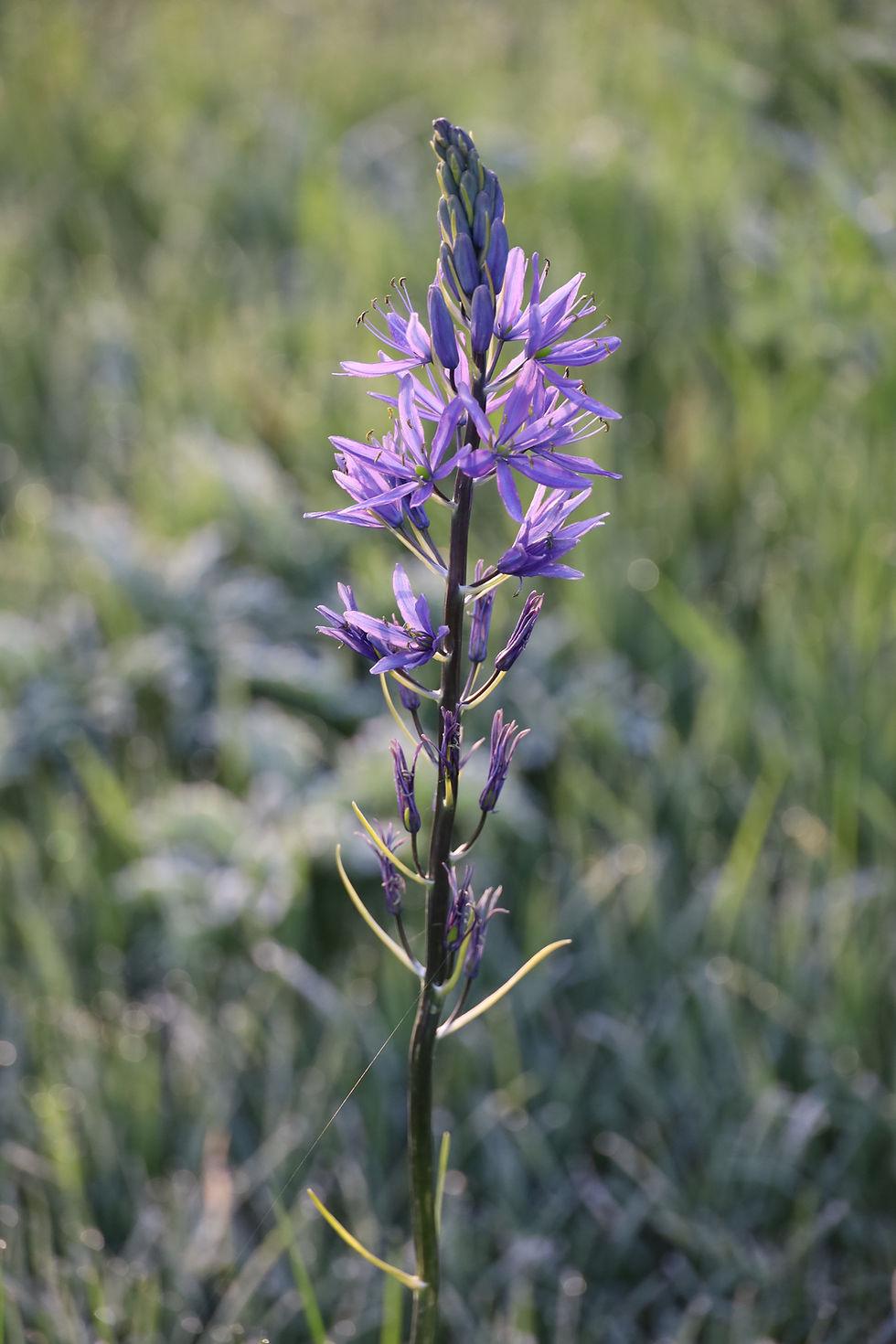
Back in autumn 2021, we planted a small number of Camassia quamash bulbs in the meadow to test how they would cope in our light, well-draining conditions. Conventional wisdom has long held that Camassia belongs in damp meadows, yet we were encouraged by a number of reports suggesting it may be more adaptable and tolerant of drier soils than previously thought. And after all, the soil here generally only becomes very dry in mid to late summer, when the bulbs are deep in dormancy and less influenced by conditions. Or so we thought...
As misfortune would have it, we timed our experiment so that the first summer our newly planted bulbs spent in the ground happened to be one of the hottest and driest on record. Unsurprisingly, the not-yet-established bulbs were unable to cope and failed to reappear the following year.
Not ones to be deterred easily, we decided to try again in autumn 2024. Our rationale was that if the bulbs could just have one favourable summer to settle in, they would be able to deal with more extreme weather thereafter. Jack carefully distributed them in the pockets of the meadow known to have marginally richer soil (indicated by more vigorous grass growth), and in areas where shade during the height of summer is cast by the canopies of apple trees.

At this point it’s probably worth stepping back briefly from our own experiment to understand the plant itself a little better – and why we were so keen to establish it in the first place.
Originating from North America, Camassia is a strappy-leaved perennial which, in late April and May, sends up tall, elegant spires of star-shaped flowers, with colours ranging from white through to deep purplish-blue depending on the species. While each delicate flower is undeniably pretty in its own right, it is the collective effect that truly captivates. When seen en masse, Camassia creates a soft haze of colour not dissimilar to bluebells carpeting a woodland floor.

In its native range, Camassia (also known as quamash) once held significant cultural and practical importance as a staple food for many Native American communities. Naturally occurring drifts were carefully managed and often fiercely protected, with harvesting rights passed down through generations. The bulbs were traditionally pit-roasted – a slow process that could take up to two days – transforming them into a sweet, nourishing food likened to baked sweet potato.

In the UK, Camassia is valued primarily as an ornamental plant. Because its foliage is slow to die back – and, as with all bulbs, is best left to do so naturally – it is particularly well suited to long-grass meadows. Here, it can complete its life cycle undisturbed, as the rest of the vegetation grows up to conceal the less-than-pretty decaying foliage. This long, unattractive 'goodbye' makes it less well-suited to borders, or to areas of grass earmarked for regular mowing. Nor are pots the best idea – Camassia bulbs resent disturbance and so don't cope well with the regular repotting needed to keep container plants fresh.
Able to tolerate moister conditions than most bulbs, Camassia is a useful way to add early colour to the damper spots in the garden. But what of its current fate in the light soil of our Orchard Meadow?
Thanks to fairly average summer weather last year, the signs are distinctly promising. Now in their second year of flowering, the clumps have noticeably increased in size, suggesting a degree of contentedness with the conditions. By all accounts, we can expect this to continue at a gradual rate over the next few years – then more rapidly from around year five onwards.

It'll be an interesting experiment to observe, and – if the plants continue to thrive – will be testament to taking the textbooks with a pinch of salt and a dose of common sense. For now, we'll simply enjoy them as they are, and the welcome splash of early colour they add to the still predominantly green meadow.


Comments